
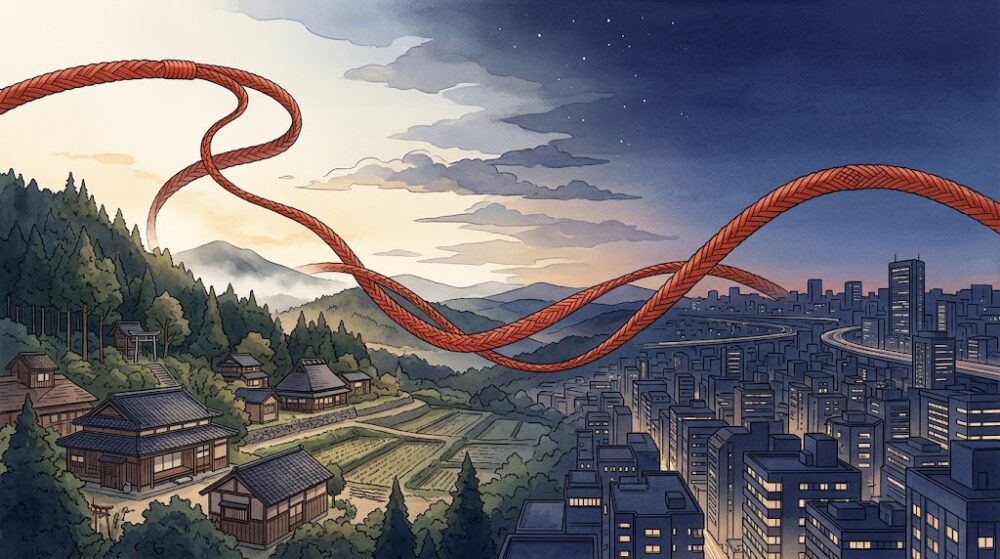
In Your Name. (君の名は。), a braided cord appears beside a story about two teenagers whose lives cross through dreams. The phrase “your name musubi meaning” points to a question: why does the film link a cord with relationships and time? Musubi (結び) can mean tying something together or forming a connection, so “knot” alone misses part of its meaning.
The film’s use of musubi is tied to the cord and to the characters’ connection, but it is not simply a claim about fate. This guide separates the everyday meaning of musubi from musuhi (産巣日), a distinct Shinto concept, and explains what the braid represents in the story.
- In Your Name, musubi links tying a cord with human bonds and the flow of time.
- The braided cord is kumihimo, not simply a generic red string of fate.
- Keep everyday musubi distinct from the related but different Shinto term musuhi.
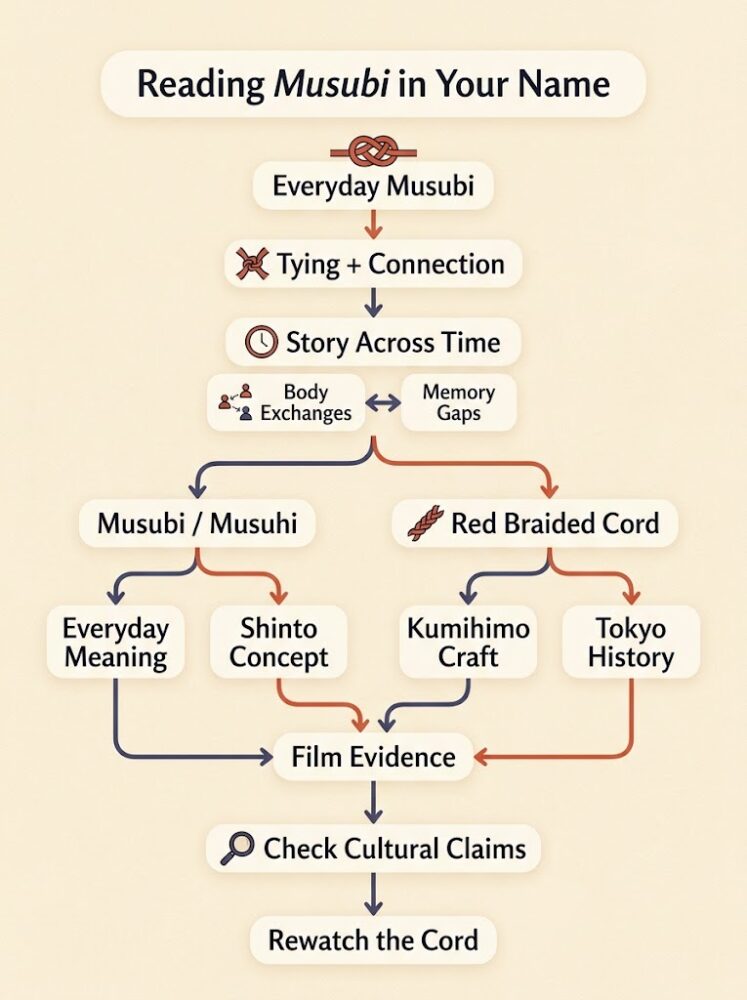
What Does Musubi (結び) Mean in Your Name?
The Everyday Meanings Behind Musubi
In Japanese, musubi (結び) can mean tying something, forming a connection, or bringing something to an end. A Japanese dictionary also records other senses, including a rice ball, so context matters. For the film, the useful starting point is not a single English substitute such as “knot,” but a word whose meanings can overlap.
The related verb musubu (結ぶ) can mean to tie with a cord or connect things. It can also describe joining a group, making an agreement, or ending a story. These senses help explain why musubi can refer to a physical tie and to a bond between people, even though the word does not mean “relationship” in every context.
The meanings work together, but they are not interchangeable. A cord can be tied, people can form a connection, and a story can reach its end; each sense depends on how the word is used. Note how the word’s meanings of tying and connection both apply to the film. This makes “knot” a starting point, not a complete explanation.
| Sense | Everyday meaning | How the film uses the idea |
|---|---|---|
| Tying | Fastening something with a cord | The braided cord makes tying tangible |
| Connection | Joining people or things | Mitsuha and Taki form a bond |
| Bringing something to an end | Concluding a story or matter | A dictionary sense, not the main meaning of their bond |
The first two rows are the clearest fit for the film’s imagery and relationship: a cord is tied, and the characters become connected. The word’s range lets these ideas sit together without making them identical. A physical tie is not itself the same thing as a personal bond.
The final row shows why context matters. Musubi can refer to an ending in ordinary Japanese, but that does not make “ending” the central meaning of Mitsuha and Taki’s connection. Read the word through the scene or use in question rather than assigning every dictionary sense to the film.
How the Film Connects Tying, Relationships, and Time
Your Name. (君の名は。), written and directed by Makoto Shinkai, follows Mitsuha Miyamizu (宮水 三葉), a high-school girl in a rural town, and Taki Tachibana (立花 瀧), a high-school boy in Tokyo. They experience dreams in which they become one another, exchange messages, and discover a special connection. Musubi gives viewers a way to read that bond alongside the film’s images of cords and time.
The film brings physical tying and human connection close together. Mitsuha’s braided cord is something that can be held and passed between people, while her link with Taki develops through their exchanges. The British Film Institute describes the film’s kumihimo braids as representing both the thread of time and connections between people. That supports reading musubi as tying and connection across time.
Time matters because the characters’ exchanges do not give them complete, reliable memories of one another. The cord’s presence helps connect events and people even when their understanding is incomplete. This is a thematic use, not a claim that musubi always means “time” in Japanese. The word’s everyday meanings help frame the film, while the story gives those meanings a particular shape.
This video shows Mitsuha’s grandmother explaining musubi, helping viewers connect the act of tying thread with relationships and the flow of time. It adds context to the film’s central symbolism.
How Musubi Connects Mitsuha and Taki Across Time
Their Body Exchanges and Messages
Their connection begins through an unusual exchange: Mitsuha Miyamizu and Taki Tachibana experience dreams in which each becomes the other. The official film synopsis places them in different settings: Mitsuha lives in a rural town, while Taki is a high-school student in Tokyo. The dreamlike form matters because their contact is not an ordinary meeting; each encounters the other through a life temporarily experienced from within.
When they exchange bodies, their connection becomes practical as well as emotional. They leave messages for one another, creating a way to respond even when they are not sharing the same experience at the same moment. Those messages make the relationship visible: one person’s choices can affect the other’s daily life, rather than remaining a private feeling.
The link is not ordinary. The exchanges give each character a reason to pay attention to someone whose life is otherwise separate from their own. Instead of explaining their bond only through dialogue, the film shows it through actions and responses: one person changes something in the other’s life, and the other has to make sense of that change.
Why Memory Gaps and Time Matter
The story gradually makes clear that their experiences do not line up neatly in time. This changes how the body exchanges and messages can be understood: what seems like direct contact does not give either character a complete picture of when the other is acting. The connection has to cross a gap, not just a distance between two places.
Memory gaps add another limit. Even as Mitsuha and Taki affect each other’s lives, they cannot rely on a full, continuous account of what has happened. The official Japanese synopsis points to gaps in their memories alongside the time difference. Together, these details make their connection something they have to piece together, rather than a relationship they can understand immediately.
This is why time belongs to the film’s idea of musubi, not only the cord’s physical act of joining. Their bond reaches across separate lives and moments, but the gaps prevent that bond from feeling simple or automatic. On a rewatch, trace how one character’s actions reach the other across their separation. The gaps matter.
Is Musubi the Same as Shinto Musuhi (産巣日)?
What Everyday Musubi Means
Everyday musubi (結び) is a Japanese noun whose meaning changes with context. Kotobank’s Digital Daijisen entry includes tying a cord, forming a connection between people, bringing something to an end, and a rice ball. These are separate uses of the same written word, not one definition that applies in every sentence.
The related verb musubu (結ぶ) can mean to tie or connect, as well as to make an agreement, finish a story, or join a group, according to Kanjipedia. The noun musubi can therefore suggest a bond or a joining, but it can also refer to a practical knot or food. Context tells you which sense is intended.
In Your Name, the word is discussed alongside ties between people and the braided cord, giving it more than a literal “knot” sense. That context helps explain why viewers connect musubi with relationships and time. It does not mean that every dictionary sense, such as “rice ball,” is active in the film’s symbolism.
| Feature | Musubi | Musuhi |
|---|---|---|
| Spelling | 結び | 産巣日 |
| Context | Everyday Japanese word | Shinto concept |
| Supplied meaning | Tying, connection, ending, or rice ball | Unseen working associated with creation |
The table separates the everyday word from the religious concept by spelling, context, and definition. Their similar romanized forms can make them appear interchangeable, but the supplied sources describe different terms and uses.
The entries do not establish that every use of musubi carries a Shinto meaning. In film discussion, keep the everyday sense distinct unless a source clearly identifies musuhi and explains that interpretation.
What Shinto Sources Say About Musuhi
Musuhi (産巣日) is a separate Shinto concept, not simply another dictionary definition of everyday musubi. The romanized terms look and sound similar, and discussions of the film may place them near each other, but their spelling and stated meanings differ. Related in discussion, but not interchangeable: that distinction prevents a cultural interpretation from replacing the ordinary word’s meaning.
Kokugakuin University’s Encyclopedia of Shinto describes musuhi as an unseen or mysterious working associated with the coming into being of heaven, earth, and all things. It also presents musuhi as a central Shinto concept. This account concerns a religious idea of creation and becoming, rather than the everyday noun’s range of uses, such as tying a cord or making a human connection.
The film can invite viewers to consider connection and the formation of bonds, but that alone does not establish that it uses musuhi as a technical religious term. Check which spelling and meaning a source uses before applying a religious interpretation to the film. Reading the terms separately lets you discuss the film’s imagery without turning a possible association into a claim about what the word must mean.
What Is Mitsuha’s Red Braid in Your Name?
Mitsuha’s Cord as a Braided Kumihimo
Mitsuha’s red braid is a kumihimo (組紐(くみひも)), a cord made by interlacing threads in a repeated pattern. That construction distinguishes it from a plain ribbon or a single strand of thread. In Your Name, the cord is more than a visual detail associated with Mitsuha; it forms part of the film’s imagery of people and time being linked.
The braid’s physical form gives the idea of connection a visible shape. Separate threads cross and hold together, creating one cord without losing their individual strands. This offers a concrete way to understand the film’s use of the braid: it suggests bonds that continue across distance and change, rather than a simple object that stands for one fixed idea.
The British Film Institute describes the film’s kumihimo cords as representing both the thread of time and connections between people. Look closely at the cord’s braided construction and how the film associates it with connection and time. This keeps the interpretation tied to details the story presents, rather than treating the braid as a universal symbol with one set meaning.
Why It Is More Than a Generic Red String
The familiar red-string-of-fate idea can be a tempting shortcut, but it does not fully explain Mitsuha’s braid. The film shows a braided cord, not simply a red thread. Its interlaced form and its links to the story’s treatment of time give it a more specific role than a generic image of two people joined by fate.
A simplified red-string motif usually focuses on a thread connecting people who are destined to meet. By contrast, Your Name gives the cord a material form and places it within a story about connection, memory, and time. The difference is not that one reading is impossible; it is that the red-string label alone leaves out what the film emphasizes.
That distinction matters. Calling the braid only a “string of fate” can make it sound like a familiar romance symbol, while the film’s cord also echoes the repeated crossing and joining of threads. The clearest reading stays close to both parts: it is a braided object in the story, and it helps express the ties between people and time.
| Feature | Your Name cord | Generic red-string motif |
|---|---|---|
| Construction | Interlaced threads forming a braid | Often shown as one thin thread |
| Form in the story | A physical cord associated with Mitsuha | A symbolic line linking people |
| Emphasis | Connection between people and the thread of time | A bond or destined meeting |
The contrast is mainly about construction and emphasis. The film’s cord is braided from interlaced threads, while a simplified red-string image is usually presented as one line joining people. The film also connects its cords with time, not only with a bond between two people.
The table separates what is visible from what the symbols suggest. This helps explain why the red-string comparison can be useful as a starting point but incomplete as a full account of Mitsuha’s braid.
What Does Kumihimo Mean Beyond Your Name?
How Kumihimo Cords Are Made
Kumihimo (組紐(くみひも)) means a cord made by interlacing threads in a repeated pattern, according to the Nara National Museum’s Shōsō-in Treasures glossary. The definition focuses on how the cord is constructed, not on a particular color, use, or story. In Your Name, the braided cord is one example of kumihimo, not a complete definition of the craft.
The pattern is the point. Kumihimo is formed by crossing and interlacing threads repeatedly, creating a braided structure rather than simply tying a loose cord into a knot. The glossary gives this basic description without specifying one required pattern or set of materials, so the term covers a method of making cords rather than just one recognizable design.
Use the Nara National Museum’s glossary to compare its description of interlaced threads with the cord shown in the film. That comparison helps separate the cord’s real construction from its role in the story: the BFI describes the film’s kumihimo cords as representing time and connections between people. Those meanings belong to the film’s presentation, while the glossary describes how kumihimo cords are made.
Historical Uses of Tokyo Kumihimo
Tokyo kumihimo (東京くみひも) has had practical uses beyond the symbolism viewers may associate with Your Name. The Tokyo Metropolitan Government describes it as a craft used historically for armor and sword fittings. These examples place the cords in the context of equipment and objects, rather than treating them only as decoration or as a sign of personal connection.
Its uses later included everyday items such as obi fasteners and netsuke cords, according to the Tokyo Metropolitan Government. An obi fastener holds a kimono sash in place, while a netsuke cord attaches a small carved object to clothing. Its function changed over time. The examples show how the same broad craft could serve different practical purposes.
The Tokyo Metropolitan Government lists February 4, 1982, as the designation date for Tokyo kumihimo. That date refers to the Tokyo craft category described on its site; it does not make the film’s red braid a historical object or define every use of kumihimo. Keeping the contexts separate makes the comparison clearer: the film emphasizes connection and time, while the government’s account records craft uses.
How to Read Musubi Without Over-Interpreting the Film
What the Film Directly Shows
Begin with what the film establishes on screen and in its official synopsis, rather than treating every image as a statement about Japan. Your Name. follows Mitsuha and Taki, two high-school students who dream of becoming one another; the synopsis also says they exchange bodies, leave messages, and discover a special connection.
The story makes memory and time part of that connection. The official synopsis mentions gaps in their memories and time, while the cord imagery gives viewers a way to picture links across separation. That is the story’s evidence.
Makoto Shinkai’s film does not provide one rule that explains every cord image or every use of musubi. The British Film Institute’s interview with Shinkai describes the braided cords as representing both the thread of time and connections between people. That account explains the film’s imagery, not a universal definition.
Where Broader Cultural Claims Need Care
Broader cultural claims need different evidence. A Japanese dictionary lists several meanings for musubi, including tying a cord and making a connection between people. Those meanings help explain why a cord can suggest a relationship, but they do not prove that every meaning applies whenever the film uses the word.
Story evidence is not cultural proof. The Shinto term musuhi sounds similar to everyday musubi, but it is a separate concept, not a simple dictionary gloss for the everyday noun. Kokugakuin University’s Encyclopedia of Shinto describes musuhi as an unseen or mysterious working associated with the coming into being of heaven, earth, and all things.
The film’s family and shrine setting belongs to its fictional story. It should not be treated as evidence that all shrines, communities, or Japanese people share one understanding of cords, relationships, or time. A symbolic choice in a film can draw on cultural ideas without defining those ideas for everyone.
Conclusion
The phrase “your name musubi meaning” offers a way to notice how a single image can bring together an object, a bond, and the passage of time without making the film a guide to religious belief. It leaves room for the story’s symbolism to stay specific to the film.
On a rewatch, pause at the cord scenes and notice what the braid is doing physically, between the characters, and in the story’s timing. Let the image keep its questions.
Sources and Further Reading
- Japan Film Database — jfdb.jp
- CoMix Wave Films — www.cwfilms.jp
- Kotobank, Digital Daijisen entry for 結び — kotobank.jp
- Kanjipedia, Japan Kanji Aptitude Testing Foundation — www.kanjipedia.jp
- Kokugakuin University, Encyclopedia of Shinto — d-museum.kokugakuin.ac.jp
- British Film Institute, Sight and Sound — www.bfi.org.uk
- Nara National Museum, The Exhibition of Shōsō-in Treasures Glossary — shosointen-glossary.narahaku.go.jp
- Tokyo Metropolitan Government, Tokyo Traditional Crafts — www.dento-tokyo.metro.tokyo.lg.jp
- Your Name. Official Japanese Website — kiminona.com